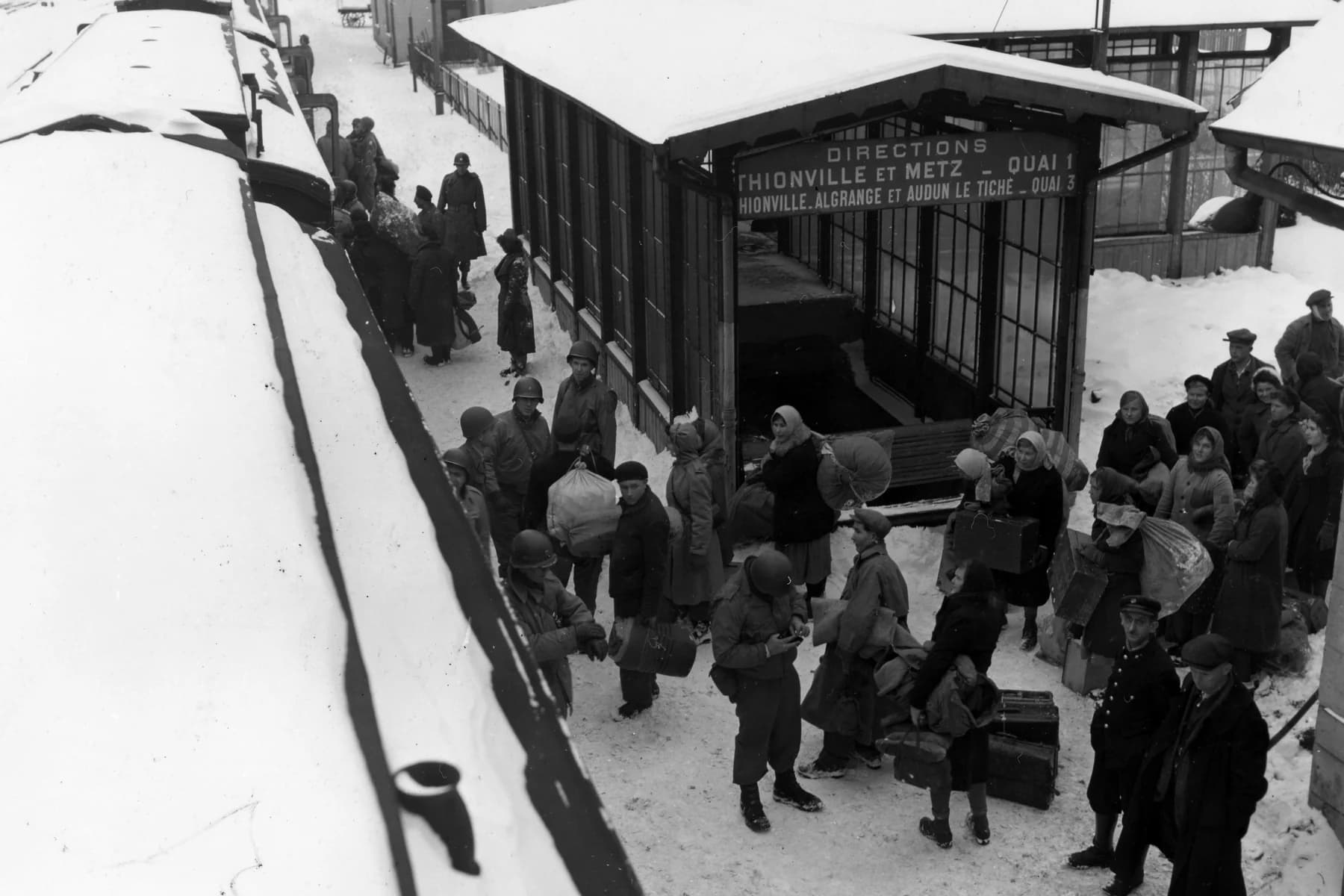
World War II did not just kill people. It decided, in a strange sideways way, which people would ever get the chance to be born.
That sounds obscene at first.
I don't mean the war was good, necessary, secretly useful, or part of some grand moral arithmetic where later lives balance out earlier graves. That way of thinking is rotten. I mean something colder and more uncomfortable: the exact biological event that made you - one egg, one sperm, one absurdly specific moment - sits on top of a pile of earlier accidents.
Move the pile slightly.
You vanish.
Not metaphorically. Not as a personality. You, the particular person reading this sentence, almost certainly do not arrive if enough tiny pieces of your family history shift by a month, a week, sometimes an evening.
History usually talks about treaties, armies, borders, leaders. Fair enough; those things matter. But under all that public drama, ordinary people were missing trains, coming home late, sleeping in refugee camps, marrying different partners, grieving the dead, starting again because there was no other option. Somewhere inside that mess, children were conceived.
Different children.
A child is not a scheduled product
Change the month of conception and you do not get the same baby with a different birthday.
You get someone else.
Same parents, maybe. Same house. Same family stories. Still, a different sperm reaches the egg, or a different egg is present in the first place, and the genetic lottery spits out another human being. We talk about conception as if it were a planned appointment. Biology is not that tidy.
This is why the idea bites. A couple separated in 1942 and reunited in 1945 did not merely postpone a child. The child who might have been conceived in 1942 never existed. Another child may have arrived later, loved just as deeply, but not identical.
The philosopher Derek Parfit gave this kind of problem a sharper name: the non-identity problem. It asks how we should think about actions that affect not only whether future people have better or worse lives, but which future people exist at all. The Stanford Encyclopedia of Philosophy has the careful version. My version is rougher: history reaches into bedrooms.
And war is very good at ruining schedules.
Germany was not just defeated. It was rearranged.
A soldier leaves in 1940. He returns in 1945, if he returns. The child he and his wife would have had in 1941 is gone from possibility, even if nobody notices the absence.
That is the cruel part.
There is no little ghost standing in the corner saying, I was supposed to be here. There is only another child later, or no child, or a new marriage, or a woman raising children alone, or a man who never comes back from the Eastern Front.
Bombing changed families. Prison camps changed them. Hunger changed them. Shame, exile, and silence changed them too. A factory worker evacuated from Hamburg meets a woman in Bavaria. A widow remarries. A couple delays children because the country is rubble and bread is not guaranteed.
No census can tell us the number of missing possible people. That number does not exist in any archive. But the logic is not hard to follow. If war changes when people meet, when they sleep together, and whether they survive, then it changes who is born.
Not in a poetic way.
In the literal genetic sense.
Europe became a continent of broken sequences
Poland lost around six million people during the war, roughly half of them Jewish. A sentence like that is almost too large to feel. It sits there like a stone.
But each death also cut future branches.
The child a murdered father might have had in 1943. The second daughter who never followed. The cousin who would have met someone at a wedding that never happened because the family was already gone. Human life is not a clean line; it is a web of appointments, attractions, illnesses, interruptions, mistakes.
France had nearly 1.8 million soldiers held as prisoners of war. Five years is not a pause button. Relationships fray. Couples wait, or don't. People return changed. Some marry the person who stayed; some marry the person who appeared during the waiting.
Italy sent men into North Africa, Russia, and the Balkans. Families were stretched across maps they never asked to understand. Even neutral countries were not sealed jars. Work moved. Trade shifted. Refugees crossed borders. Wartime economies dragged people into unfamiliar places.
A delay of three months is enough.
That is the nasty elegance of the argument: it does not require dramatic romance, secret affairs, or Hollywood coincidence. A late train can do it. A posting order can do it. A fever can do it. So can a government form stamped by a bored clerk.
The Soviet wound was demographic and private
The Soviet Union lost about 27 million people.
Say it slowly and it still does not become graspable.
Those deaths were not only military losses or national trauma. They changed marriage markets, village life, family formation, and the pool of possible parents. A woman who might have married one man marries another because the first is dead outside Stalingrad. Their children are not substitutes. They are different people, born from a different pairing, carrying a different mixture of ancestry forward.
Post-war Soviet society had to live with a brutal gender imbalance. The state wanted births. Families wanted continuity. People wanted love, or at least companionship, or simply a way to endure.
It is tempting to talk about this at the scale of population graphs. I find that too clean. The real story is uglier: kitchens, ration lines, letters that stopped coming, photographs kept in drawers, children who grew up with a father they would not have had in another world.
That does not make their lives lesser.
It makes them contingent.
The American baby boom was not inevitable
The United States is sometimes treated as the bright postscript: soldiers come home, suburbs rise, babies arrive, refrigerators hum.
Too simple.
The baby boom had many ingredients: prosperity, housing policy, marriage patterns, medical change, cultural pressure, and yes, the return of millions of men from war. The US Census Bureau counts roughly 76 million Americans born from 1946 through 1964 as part of the baby-boom cohort. Its population report on the baby boom gives the demographic frame.
But imagine the war never happens. Many couples marry earlier. Some never meet. Some men never leave home. Some women never take wartime work that changes who they become and who they want. Children are conceived in 1942 instead of 1946, or with different partners, or not at all.
The America that followed the war was not merely America plus victory.
It was a different human inventory.
That phrase sounds harsh. I mean it to. We soften history too quickly. We say "the post-war generation" as if a generation were poured from a mold. It wasn't. It was assembled from delayed bodies, returned soldiers, dead brothers, changed women, cheap houses, fear of communism, church pressure, optimism, exhaustion, and sex.
What about people far from the front?
Not every family line was equally shaken.
If your grandparents lived in a part of South India, rural China, Latin America, or inland Africa where the war did not directly move them, maybe the timing stayed close enough. Maybe your parent would still have been conceived in roughly the same month. Maybe you, genetically speaking, had a better chance of arriving.
Maybe.
But "far from the front" is not the same as untouched. World War II accelerated decolonisation, reshaped trade, hardened the Cold War, produced new institutions, moved technology, and helped redraw the political weather of the twentieth century. India, for instance, did not pass through the 1940s untouched by war. No major society did.
Still, I want to be careful. Counterfactual history is not a magic machine. We cannot open a second timeline and count who appears. Anyone giving exact percentages is pretending.
The honest claim is smaller, and more disturbing: once a huge event shifts mating, migration, survival, and timing across millions of lives, it almost certainly changes the identities of many later people.
Hitler had no children. That is not the end of it.
Hitler did not pass on DNA.
Yet the war he made helped rearrange the DNA combinations of later generations, because biology does not care whether influence travels through chromosomes or through chaos. A dictator can fail as an ancestor and still alter who becomes a descendant of everyone else.
That is not a mystical claim. It is just cause and timing wearing a grim face.
One decision sends a man east. One bombing sends a family west. One prison camp delays a husband. One death changes a widow's future. One new marriage produces children who could not have existed before. Then those children grow up, meet other people, and the branching keeps going.
At some point the chain reaches us.
I don't find this comforting. I find it humbling, and a little nauseating. We like to treat our existence as solid, as if we were waiting in some cosmic queue until history delivered us. But there was no queue. There was only a wild sequence of fragile events, most of them invisible to the people living through them.
You were not inevitable.
Neither was I.
That does not make life meaningless. If anything, it makes it stranger. Every person is a survivor of possibilities that never happened, walking around with the borrowed confidence of someone who almost certainly should not be here. The next war, famine, migration, or pandemic will do the same thing again - not only changing how people live, but quietly deciding who gets to exist.