The easiest version of the cosmological argument is also the weakest: everything has a cause; the universe is a thing; therefore somebody caused the universe. A schoolchild might object that this reasoning creates a regress. Who caused the somebody?
This objection is satisfying and usually effective against that crude version. Serious defenders of cosmological arguments do not claim that everything has a cause, only that contingent things require explanations, that whatever begins to exist has a cause, or that contingent reality as a whole requires a ground whereas necessary reality does not. If I want to object, I should object to those claims.
The title of this essay serves as my reminder. A coffee mug is a contingent thing, one we understand as having been made. Its making involved clay, labour, heat, machines, money, transportation, and time before it became a thing in my cabinet. The universe is not another manufactured thing alongside the mug, the machines, and the mason jars. It is the context for them all, the setting in which things are made, people are formed, time is measured, and laws are found. Maybe that context has a cause. The analogy alone does not show that it needs one.
Two arguments that should not be confused
The first distinction to make concerns two arguments that fall under the cosmological heading. The most discussed versions in recent decades include the kalām argument and arguments from contingency. They are distinct, but they appeal to related principles.
In its familiar modern form, the kalām argument proceeds:
- Anything that begins to exist has a cause.
- The universe began to exist.
- Therefore, the universe has a cause.
An argument from contingency takes a different route:
- Contingent things (things that might not have existed) do exist.
- Contingent things require an adequate explanation for their existence.
- A collection of contingent things cannot provide a complete explanation for all contingent reality.
- Therefore, a complete explanation must include a non-contingent, or necessary, ground.
Neither argument assumes that everything has a cause except for a favoured exemption. The disputes concern whether these metaphysical categories are defensible, whether the causal and explanatory principles are true, and whether a divine mind is the best candidate for a necessary ground.
I am inclined to reject both arguments, but not because they are silly. They have force partly because they expose a dissatisfaction that naturalism cannot easily resolve: there is something rather than nothing, and every explanation we can imagine seems to require something else as its ground.
Causes come from within time
If I knock the coffee mug off my desk, it will land with a crash. The fall caused the crash; my thoughtless knocking caused the fall. These events happened one after another within time and physical space. Even when causal relations are difficult to discern, as they are at the quantum level, the theories we use describe states, events, and dependencies within a physical framework.
What could cause time itself to begin? The theologian may reply with a statement about God's timelessness, declaring that the cause of the universe is outside time and that effects within time need not have temporally earlier causes. That response is not unreasonable, but it breaks the analogy with the temporal causes that made the original premise feel intuitive. We have moved from knockings, fallings, and crashings to a relation no one entirely understands. The move from temporal to atemporal causation may be justified, but it cannot simply borrow its plausibility from falling mugs.
Another problem concerns the nature of the causal relation. Causes can be described as events, entities, conditions, or relations, depending on the theory being used. If there was no earlier physical state from which the universe changed, ordinary event-causation may not be the right model. Perhaps “cause” in this setting means explanation, dependence, or metaphysical grounding. That does not solve the problem; it reframes it. The word carries philosophical freight that depends on a theory of explanation.
The Big Bang is not a creation scene
At this point, the dispute between the kalām argument and naturalism turns partly on theories of explanation and partly on what cosmology can establish. Contemporary cosmology does not prove an absolute beginning to all reality, but it does not rule one out. The Big Bang model describes expansion from an early hot, dense state; it does not depict creation from nothing inside a pre-existing physical space.
NASA's account of cosmic history describes an early period of inflation and the later expansion and development of the universe. It also says scientists are not sure what came before inflation or what powered it. We are dealing with a frontier of knowledge, not a datum about the final metaphysical structure of reality. “We do not know” is not an argument for God or for an uncaused universe.
The kalām argument's second premise, that the universe began to exist, is therefore not as secure as its defenders might like. Some cosmological proposals explore bounces, quantum beginnings, or forms of past extension. Their scientific status varies, and none can be adopted merely because it is convenient for an argument. Their philosophical relevance also depends on whether a finite physical description counts as an absolute beginning of existence.
I am sceptical of appeals to cosmology that treat a successful account of the early universe as if it had already settled the regress problem.
Quantum physics does not allow free universes
One objection to the first premise of the kalām argument concerns quantum physics. Some quantum events appear not to have deterministic prior causes. That is more careful than saying they occur without causes, and the difference matters.
Quantum theory predicts outcomes with extraordinary precision, but philosophers and physicists do not agree on what the formalism says reality is doing. Collapse theories include genuinely indeterministic changes. Everettian, or many-worlds, interpretations retain deterministic evolution of the universal wavefunction and deny that a unique physical collapse occurs. Other interpretations propose still different accounts. The Stanford Encyclopedia of Philosophy's entry on quantum mechanics reflects this continuing disagreement in quantum foundations.
The quantum vacuum is not nothing; it is a physical condition described by fields, rules, and possible states. The idea that a universe might arise from a quantum condition is intriguing, but it does not explain why that condition or those rules obtain.
Quantum physics complicates simple causal principles without deciding the cosmological argument. Indeterminacy may be relevant to causation, but it does not automatically produce an uncaused universe. Both the theist and the atheist can invoke intuitively reasonable principles that the physics does not straightforwardly confirm.
A necessary ground does not yet give us God
The contingency argument avoids some difficulties of the kalām argument. It does not assume that the universe began to exist. It claims that contingent reality needs a ground and that an explanation made only of further contingent things would remain incomplete.
This version faces its own objections. Its conclusion depends on a principle of sufficient reason and on the claim that contingent things alone cannot completely explain contingent reality. Those premises are disputed. Even if I grant that reality requires a necessary ground, it does not follow without further argument that the ground is a conscious being. A necessary structure, law, or other non-personal foundation may also be proposed, though each candidate brings difficulties of its own.
Moving from a necessary ground to a personal creator requires more philosophical work. A necessary conscious mind capable of grounding contingent existence is an ambitious commitment, even if one with considerable appeal for some theologians and philosophers. Classical theists may describe such a being as simple or without parts, but technical simplicity does not make the proposal immediately intelligible.
The naturalist has no effortless alternative. If physical reality is contingent and has no further ground, then it becomes a brute contingent fact. The theist can fairly ask why that stopping point is less mysterious than a necessary being. The naturalist can ask why describing the stopping point as a necessary consciousness explains more than it asserts. Each position has the right to press the other.
Explanations threaten to go on forever
Imagine that every fact requires another fact to explain it. Are we dealing with an infinite regress, a necessary ground, an explanatory circle, or a brute fact?
Each alternative violates some expectation. An infinite regress never arrives at a final explanation; a circle appears to make its members depend upon one another; necessity can look like a label attached where inquiry stops; a brute fact denies that further explanation is available. Philosophers defend versions of all four options, so discomfort alone cannot decide among them.
This is hard to accept because our intuitions about explanation pull in opposing directions. If something is contingent, it seems natural to ask why it exists. Yet if every answer requires another answer, explanation never finishes. The possible resolution is not that no facts need explanations, but that not every fact can require a further explanation of the same kind.
At this point, the cosmological argument becomes a dispute about the structure and limits of explanation. Explanations are accounts we construct to understand reality, but they may track real relations of cause or dependence within it. The difficult question is whether the demand that works so well inside the universe must also apply to reality as a whole.
Some philosophers argue that if inquiry reaches fundamental facts or structures, asking for another explanation may be misplaced. I am sympathetic to that view, but calling a physical structure “necessary” does not make its necessity an experimental discovery. It remains a metaphysical claim about how reality could or could not have been.
What the Webb image actually shows
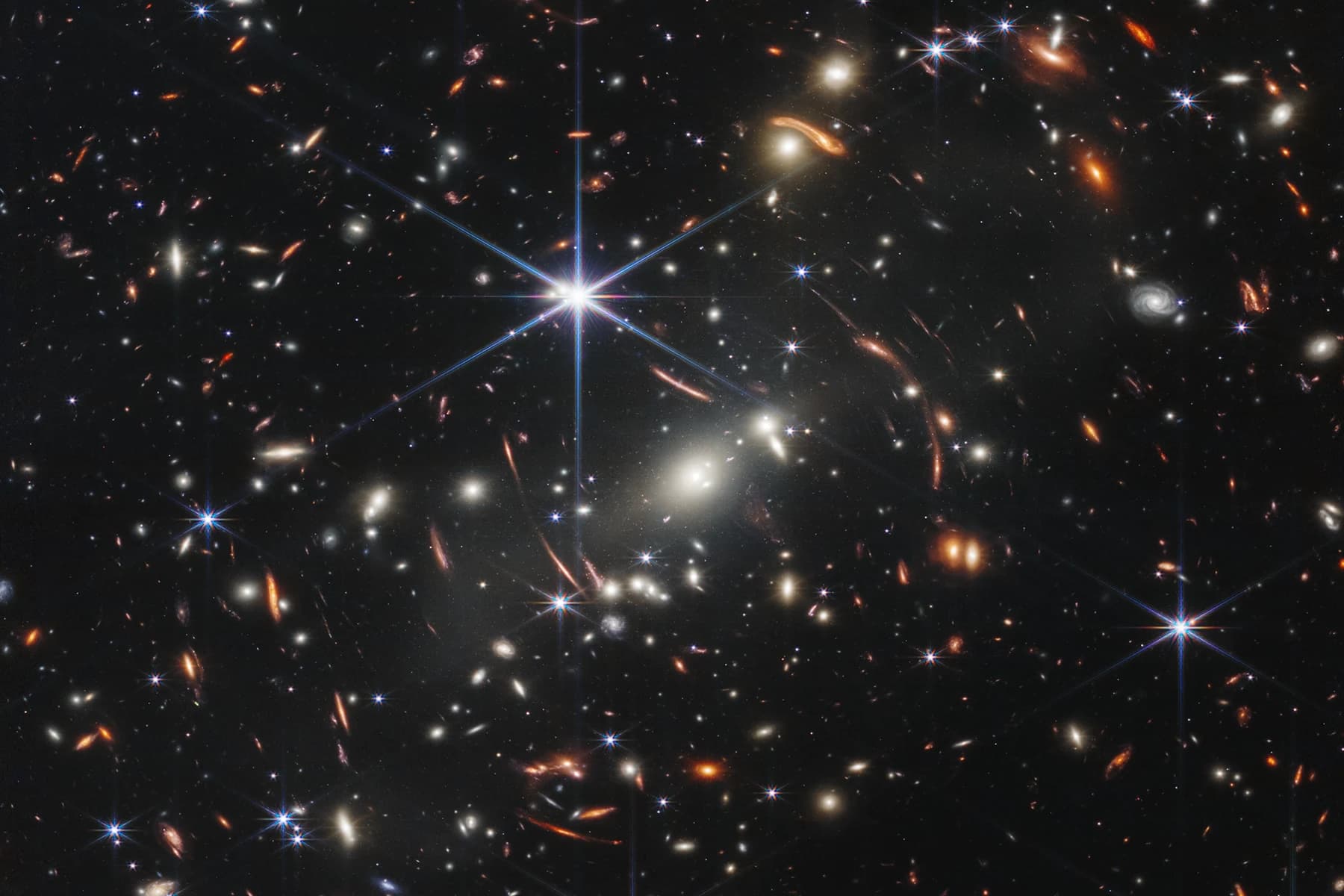
Webb's First Deep Field is a remarkable image taken by the James Webb Space Telescope. It shows thousands of galaxies in a patch of sky approximately the size of a grain of sand held at arm's length. The foreground cluster acts as a gravitational lens, distorting and magnifying the light from more distant galaxies behind it.
It also sees into the past. The cluster SMACS 0723 appears as it was 4.6 billion years ago, while the galaxies magnified behind it are more distant. Yet the image says little about why there is a universe. The long journey of the light is evidence of those galaxies and their history, but it does not explain existence itself.
The image suggests two kinds of wonder. One is the wonder we feel when we understand how the universe works: when we build instruments, test ideas, and find new ways to measure and predict. The other appears when our explanations run out and we confront the fact that anything exists at all. Religious and non-religious people can experience both. Science does not need to dismiss God in order to investigate nature, and religion does not own the mystery that remains.
I think the coffee-mug intuition is misleading. Manufactured things have makers, but the universe is not obviously a manufactured thing. Rejecting that analogy does not establish that the universe is self-caused, uncaused, necessary, or a brute fact. These are different claims. A self-caused thing would somehow cause itself; an uncaused thing would have no cause; a necessary reality could not have failed to exist; a brute fact is a fact for which no further explanation is available. They should not be treated as interchangeable.
Necessity remains useful as a philosophical category even if we doubt that it identifies anything outside logic or mathematics. The argument is about whether some reality exists necessarily, not whether surprise can be renamed necessity. Nor is metaphysical necessity merely subjective evaluation: philosophers disagree about its basis, but the claim is meant to describe how reality could have been, not how somebody happens to feel about it.
What Webb really shows is a universe far larger and older than ordinary experience prepares us to imagine, one that has nevertheless yielded to careful observation. It has given us remarkable insight into how the universe developed, but not a final answer to why there is a universe or why its laws have the form they do.
The coffee mug cannot answer that question. Neither can a slogan about God, quantum nothingness, necessity, or brute facts. What remains is a choice among difficult possibilities, and I do not think we yet know which kind of explanation, if any, reality ultimately permits.
Explore the evidence