The material leads
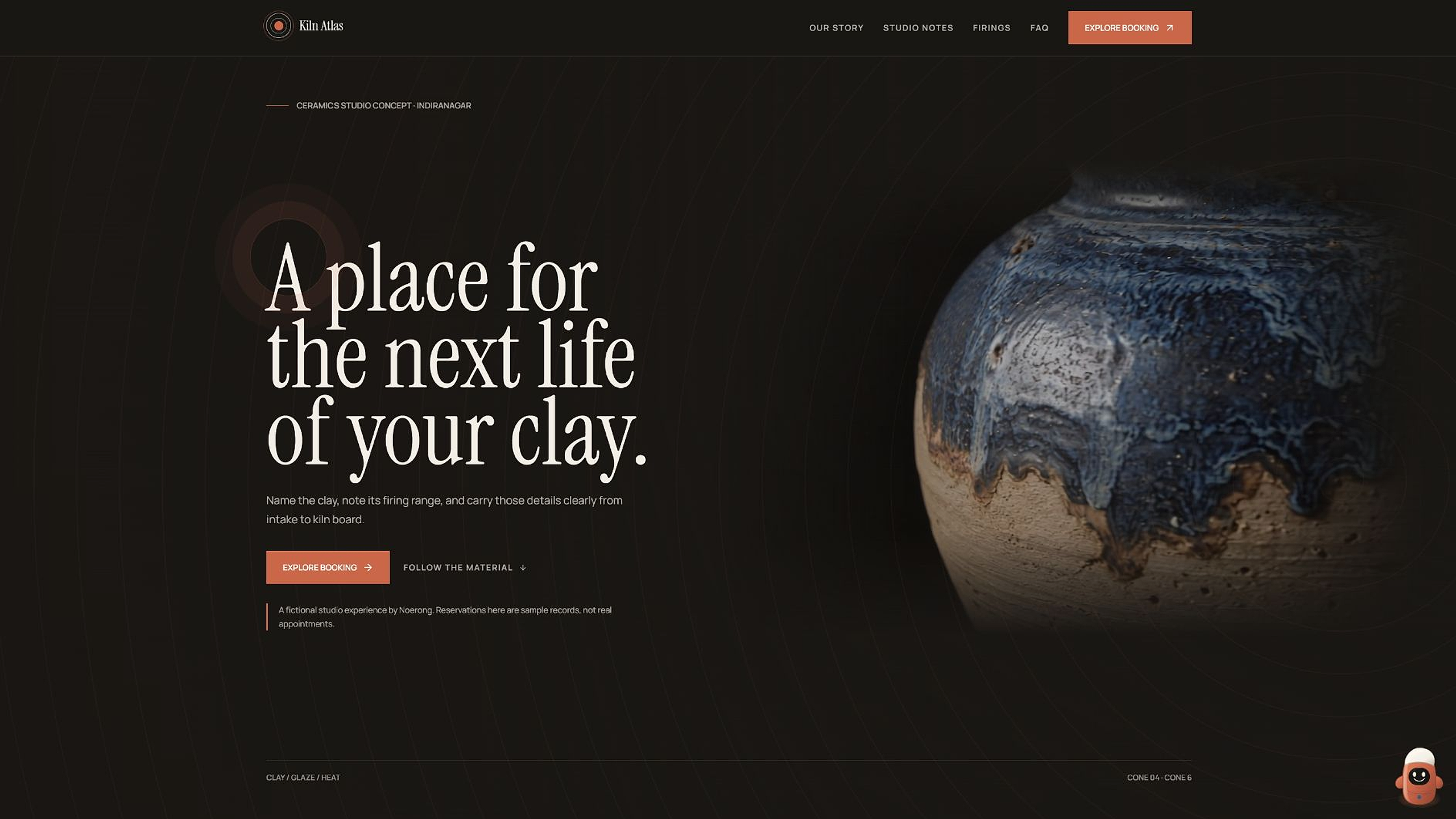
Stoneware imagery, kiln-dark surfaces, warm clay accents, and measured typography give the fictional studio a distinct identity before asking for form details.
Live product · Lovable AI challenge concept
A fictional ceramics studio concept that turns a vague firing inquiry into a structured sample reservation and an owner-ready review record.
The product
Kiln Atlas is a fictional client brief for a solo ceramics studio in Indiranagar, Bengaluru. The owner has limited 20-minute drop-off windows, needs material information before accepting work, and loses time gathering missing details across messages. The complete product, including its public site, booking flow, data, AI companion, and private workbench, was created from start to finish in Lovable AI under Noerong's direction.
The design thinking
A ceramics booking tool should feel as considered as the material practice it supports. Editorial storytelling builds trust, while the operational flow stays precise about what a reservation can and cannot decide.
Stoneware imagery, kiln-dark surfaces, warm clay accents, and measured typography give the fictional studio a distinct identity before asking for form details.
Material and scheduling answers move from booking to confirmation and owner review as one record, reducing repeated questions.
Availability and information capture are streamlined, while firing compatibility remains an explicit owner decision.
Product walkthrough
A narrated walkthrough from the public studio story and Ember assistant through booking, confirmation, and the private owner workbench.
1280 × 628 video · 2 minutes 54 seconds · Voice-over included
Product approach
The experience treats booking as a careful handoff. A visitor chooses a firing, records piece and material details, selects a sample window, reviews the request, and receives a reference. The matching record reaches a protected owner workbench where it can be searched, reviewed, rescheduled, cancelled, and moved toward a simulated kiln board. Ember answers preparation questions without replacing human material judgment.
Core system
Service, dimensions, clay body, rated cone, readiness, glaze information, notes, contact details, and a limited drop-off window are collected in one guided reservation.
The completed request returns its chosen time, firing type, and reference number, replacing an open-ended inquiry with a record both sides can identify.
Reservations are grouped by date and status with search, review, reschedule, cancellation, and history controls. The owner walkthrough shows this protected workflow without exposing owner access.
The system gathers compatibility evidence but never claims to approve or fire physical work. A person records the simulated review outcome before a record can advance.
A friendly ceramic companion greets visitors and answers preparation and firing questions. It can be hidden or replayed without turning the booking into another chat thread.
Behind the booking
The owner experience is half the product. For a solo ceramics studio, the work begins when a reservation arrives: finding the right details, checking the material, protecting intake time and keeping the next step visible.
The live workbench requires owner access. This visual tour opens up that workflow for reviewers, using fictional sample records captured from the running product.
Open owner workbenchOwner sign-in required. No public credentials are shared. You can review every screen below without an account.
Ask for missing clay details, negotiate a drop-off time, find the original message and explain the next stage again.
Receive a structured reservation, review it in one place and carry the decision forward with the material details attached.
Inspect physical work and decide what can safely proceed. The concept organizes that decision; it does not make it.
Owner workflow / 01
The public booking journey stays open to visitors. Studio operations sit behind a one-time email sign-in link, with access limited to the verified owner account. The workbench link is included here so reviewers can see the access boundary; the screenshots document the screens beyond it.
Owner effort reducedCustomers can book without an account. The owner's operational controls remain private.
Owner workflow / 02
The bench groups sample reservations by day and time. New, inspected and attention counts give the owner a quick overview. Filters separate upcoming work, records awaiting review, items needing attention, accepted samples, past samples and cancellations. Search brings a name, reference or clay detail back into view.
Owner effort reducedReplaces sorting through message threads with one queue the owner can work through.
Owner workflow / 03
Open a reservation and the sample contact, dimensions, clay body, rated cone, dryness answer and customer notes sit together. The reference KA-ZDCA-BR4S matches the booking in the narrated walkthrough: one mug, Thursday 1 October at noon. Review, reschedule, cancel and history controls stay beside that record.
Owner effort reducedThe owner does not need to retype the intake or ask for details already supplied in the booking flow.
Owner workflow / 04
The review form offers three outcomes: accepted, needs clarification or declined in simulation. A private studio note is separate from the optional note shown on the customer's private sample page. This distinguishes an administrative reservation from the material review that still belongs to a person.
Owner effort reducedKeeps the decision and its explanation with the piece, instead of scattering them across private notes and customer messages.
Owner workflow / 05
The owner selects working days, the first slot and the end of the intake day. Sample windows are 20 minutes, with one record per window, offered 21 days ahead. Whole-day and single-slot blocks accommodate exceptions. These settings feed the public availability journey; changing hours does not silently move or cancel existing reservations.
Owner effort reducedReduces repeated availability negotiations while preserving control over the studio's limited intake time.
Owner workflow / 06
The board separates cone 04 bisque from cone 6 glaze. Accepted samples wait in their matching lane, and the batch form collects a name and an optional load or capacity note. The interface describes planned, firing, cooling and complete stages. This capture shows the empty planning state, before any batch has been created.
Owner effort reducedGives the owner a shared place for the next stage of work, with firing types kept distinct.
Owner workflow / 07
Ember's answer editor lets the owner maintain questions, answers, destination links, link labels, display order and publication status. Preparation guidance and the route to booking can be kept consistent. These published notes and sample hours support the companion's responses; material acceptance remains an owner decision.
Owner effort reducedTurns repeated explanations into maintained guidance visitors can find before contacting the owner.
These screens show a functioning portfolio concept with fictional records. Effort reduction describes the intended workflow benefit, not measured customer results. Booking confirmations and progress are shown in the product; transactional booking emails, automated reminders, payments and physical firing are outside this build.
Architecture
The full experience was created in Lovable AI, including the responsive public site, multi-step booking flow, Lovable Cloud records, protected email-link owner access, DeepSeek-powered Ember assistant, and deployed build. Noerong supplied the fictional client brief, product direction, content, prompts, review criteria, testing, and refinement.
Outcome and boundaries
The working concept demonstrates the full path from an inbound firing question to a recorded sample booking. A test journey produced reference KA-ZDCA-BR4S for Thursday, 1 October at 12:00 pm, and the same reference appears in the private workbench with its material details. This is verified product behavior using fictional records, not a measured business result.
Kiln Atlas is a public portfolio concept, not an operating ceramics studio and not a product offered for sale. Reservations, reviews, kiln stages, and assistant conversations are simulations. It does not send transactional email, take payment, inspect physical clay, confirm firing compatibility, or create real appointments. A real launch would require a verified studio, service policies, transactional messaging, monitoring, and production data controls.
Created entirely in Lovable AI under Noerong's product direction. Presented as portfolio work, not for sale.